Capabilities
Eight service lines, one operating system for capital.
Risk to Business
Feb 16 2021 | Occams Marketing
429Recent Posts
Archives

Risk to Business
Feb 16 2021 | Occams Marketing
429What is corporate risk?
Business risk is a business or organization's vulnerability to factor(s) that can decrease its profitability or cause it to collapse. Anything that undermines the ability of a company to fulfil its financial targets is called a business risk. To build market risk, there are several variables that can collide. It is often the top leadership or management of an organisation that causes circumstances where a company might be subject to a higher degree of risk.
The source of risk, however, is often external to a business. Because of this, it is difficult for a business to defend itself fully from harm. There are, however, ways of minimising the overall risks involved with running a business; most organisations achieve this by implementing a risk management approach.
Main Takeaways
- Any exposure a corporation or company has to factor(s) that can lower its earnings or cause it to go bankrupt is a business risk.
- Business risk sources are diverse, but they can vary from changes in consumer taste and demand, the state of the economy as a whole, and the rules and regulations of the government.
- While businesses will not be able to eliminate business risk entirely, they may take measures to minimise its effects, including designing a strategic risk strategy.
Business Risk Understanding
When a company faces a high degree of business risk, it can compromise its ability to offer sufficient returns to investors and stakeholders. For example, a company's CEO may make certain choices that impact its earnings, or in the future, the CEO may not correctly predict certain events, allowing the company to suffer losses or collapse.
A variety of different factors impact market risk, including:
- Consumer expectations, consumption, and quantities of sales
- Price per-unit and cost of input
- The Rivalry
- The general climate of the economy
- Regulations of the Government
A company with a higher amount of business risk may decide to follow a lower leverage ratio capital structure to ensure that it can satisfy its financial obligations at all times. With a low leverage ratio, the company will not be able to pay its debt as sales decline (and this may lead to bankruptcy). On the other hand, a corporation with a low leverage ratio enjoys larger earnings as sales grow and is able to keep up with its commitments.
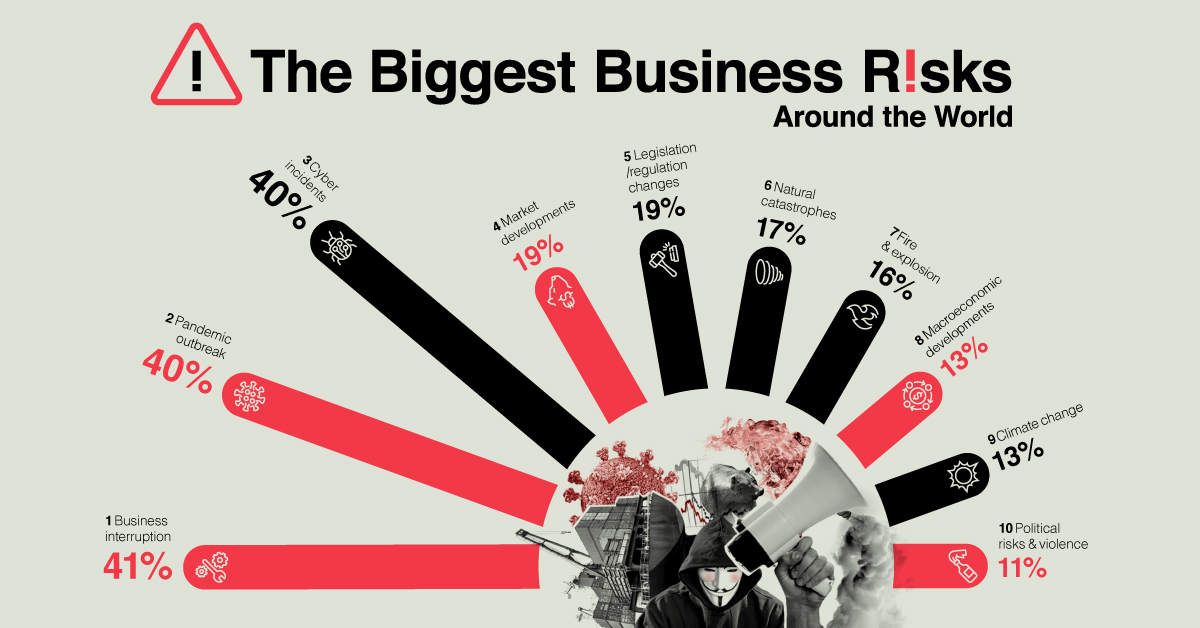
Analysts use four basic equations to quantify risk: commitment margin, leverage effect of activities, financial leverage effect, and overall leverage effect. Analysts should integrate mathematical techniques for more complicated calculations. Usually, market risk arises in one of four ways: competitive risk, risk of compliance, organisational risk, and risk of credibility.
Company Risk Forms
The Strategic Risk
Strategic risk happens when an organisation does not work according to its business model or strategy. If an organisation does not perform according to its business model, its plan becomes less effective over time and it will fail to meet its established goals. For instance, if Walmart strategically places itself as a low-cost supplier and Aim tries to undercut the costs of Walmart, Walmart becomes a competitive danger.
Chance for Compliance
Compliance risk is referred to as the second category of market risk. Compliance risk exists mainly in heavily regulated markets and sectors. In the wine industry, for example, there is a three-tier delivery structure that allows wholesalers to distribute wine to a store in the U.S. (who then sells it to consumers). This scheme prevents wineries in some states from exporting their goods directly to retail stores.
There are, however, many U.S. states that do not have this sort of logistics system; there is a chance of compliance where a brand fails to recognise the particular specifications of the state in which it resides. A brand avoids being non-compliant with state-specific delivery regulations in this case.
Chance of service
Operational risk is the third kind of market risk. This danger emerges from inside the organisation, especially when a company's day-to-day practises do not function. In 2012, for example, the international bank HSBC faced a high degree of operating risk and received a substantial fine from the U.S. as a result. Department of Justice because it was unable to adequately combat money smuggling in Mexico through the own anti-money laundering operations unit.
Damage to credibility
Any time the credibility of a company is destroyed, either by an incident that was the product of a prior market risk or by a new event, it runs the risk of losing clients and suffering from its brand loyalty. In the wake of the fine it was imposed for weak anti-money laundering activities, HSBC's image faltered.
Unique Reflections
It is not possible to eliminate market risk entirely because it is volatile. There are, however, many techniques employed by firms to reduce the effect of all forms of organisation risk, including financial, compliance, organisational, and reputational risk.
The first move that brands usually take is to define in their business strategy all sources of risk. These are not only global threats, but can also come from within the enterprise itself. It is important to take steps to reduce the threats as soon as they show themselves. In order to cope with any identifiable threats before they become too big, management can come up with a strategy.
When a company's management has formulated a strategy to deal with the risk, it is important that they take the additional step of recording everything in case the same scenario happens again. Business risk, after all, is not static; over the business cycle, it continues to repeat itself.
Finally, a risk control approach is implemented by most firms. This can be done either before or after the organisation launches operations and suffers a failure. Ideally, a risk control plan would allow the business to be more positioned when they present themselves to cope with risks. In the event that danger poses itself, the proposal may have checked concepts and processes in place.
#BusinessRisk #GovernmentRegulations #Competition #ConsumerDemand #ComplianceRisk
Article Credits –
investopedia.com


